
Wickett Group Site Induction & SWMS
Site Address:
INSERT PROJECT ADDRESS HERE
Nearest Cross Streets:
INSERT CLOSEST CROSS STREET HERE
Key Contacts
Working Hours
- Monday to Friday: UPDATE TIMES (Safety inspections permitted from 7am)
- Saturdays: UPDATE TIMES (Safety inspections permitted from 7am)
- Sundays & Public Holidays: No work is permitted at any time
General Construction Induction Training Card (White Card)
Anyone entering or working on a Wickett Group site must have a current General Construction Induction Training Card (White Card) as per Regulation 317 of the WHS Regulation 2017 (NSW). The site manager or any other representative of Wickett Group may request to see this at any time. You may provide your physical card or your digital card on the Service NSW app. If you cannot provide a white card, you will not be permitted to work on site.
General Site Rules
The site entry points are to be kept clear in case of an emergency - allowing easy entry/exit into the site.
- You must sign in & out of site upon starting and completing work each day
- If you are undertaking high risk construction work, you must read, review, and sign a SWMS relating to the work you will be undertaking.
- High visibility vests / shirts are to be worn upon instruction by Skye Wickett or a representative of Wickett Group.
- All construction workers are to wear safety boots / enclosed shoes.
- Only trained persons are to operate machinery.
- No alcohol and non-prescription drugs are allowed on site.
- Appropriate PPE must be worn as indicated on Safe Work Method Statements, Safety Data Sheets (SDS) or signage.
- Report any unsafe conditions or practices to Skye Wickett or a representative of Wickett Group immediately.
- Keep your work area tidy and free of waste materials.
- All personnel are to uphold the Principal Contractor commitment to a sustainable environment and consider Reducing, Re-Use, and Recycling.
- Always refer to the relevant SDS when using and storing hazardous substances or chemicals.
- All leads and electrical equipment must have up to date tagging.
Emergency Evacuation
In the event of an emergency evacuation taking place, the following process should be followed:
- 1All available site representatives will assemble at the site entry and coordinate the evacuation.
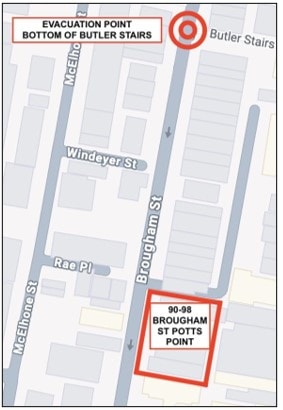
- 2The site manager will evacuate the site and take the daily site register to the assembly point & check that persons on the register are present.
- 3The Site Manager is to call 000 and coordinate with emergency responders, advising of any restrictions.
- 4The Site Manager will check each level of the project to ensure no one is on site, if safe to do so.
- 5The First Aid Officer will triage any injured person/s until help arrives. Do not move any injured person/s, unless staying in place puts you or them at further risk of injury.
- 6All site personnel are to evacuate to the indicated location as shown above.
Injuries & Emergencies
In the event of a serious accident or emergency, you should call 000 & follow their instructions. Never put yourself at risk to injury or harm. First aid is located in the site office. For non-urgent situations, you can call/visit one of the nearest essential services:
Emergency Services
Unexpected Finds Procedure
- 1Stop work immediately, notify the site management representative.
- 2Do not put yourself at risk of possible exposure by entering into, walking on or traversing the affected area.
- 3Calmly remove all persons within a close proximity to the affected area, by directing them via an agreed path of egress.
- 4Establish an exclusion zone by installing a physical barrier and signage (without any dust disturbance) to prevent any exposure to the affected area through unauthorised access.
- 5If your affected work environment allows you to do so, seal off the affected area. (Providing you do not put yourself at risk of exposure to airborne particles.)
- 6Site management representative is to contact, inform & consult about controls with the regulator (SafeWork NSW Ph: 131050) to determine if the discovery is a notifiable incident.
- 7Engage a qualified licensed asbestos assessor or occupational hygienist to inspect material and conduct testing and analysis.
- 8Determine the level of exposure sustained to the person that discovered the hazardous material(s) and conduct health monitoring as required.
- 9In consultation with the qualified licensed asbestos assessor or occupational hygienist, engage a licensed asbestos removalist to remove Asbestos Contaminated Material (ACM) or Lead containing material(s) and conduct decontamination activities for the affected area.
- 10Obtain a "Clearance Certificate" from the licensed asbestos assessor or occupational hygienist.
- 11Obtain a copy of the tipping receipts from the licensed asbestos removalist, as evidence of lawful disposal.
High Risk Construction Work (HRCW) & Safe Work Method Statement (SWMS)
When working on site, you should assess the risk of all activities/tasks that fall under the category of High Risk Construction Work, as well as any other activities/tasks that you think may be high risk. Activities/tasks that are classified as 'High Risk Construction Work' by SafeWork NSW include:
- Risk of a person falling more than 2 metres
- Demolition of a load-bearing structure
- Work likely to involve disturbing asbestos
- Temporary load-bearing support for structural alterations or repairs
- Work in or near a confined space
- Work in or near a shaft, trench or tunnel deeper than 1.5m
- Work on or near pressurised gas mains or piping
- Work on or near chemical, fuel or refrigerant lines
- Work on or near energised electrical installations or services
- Work in an area that may have a contaminated or flammable atmosphere
- Work involving tilt-up or precast concrete elements
- Work on, in or adjacent to a road, railway, shipping lane or other traffic corridor used by vehicles/pedestrians
- Work in an area with movement of powered mobile plant
- Work in an area with artificial extremes of temperature (very hot or cold environments)
- Work in or near water or other liquid that involves a risk of drowning
- Work involving diving
- Work involving explosives
- Work carried out in an area with the risk of a person being buried (e.g. excavation collapse, trenching)
As per 'Work Health and Safety Regulation 2017 (NSW), Regulation 299' It is a requirement of all subcontractors carrying out HRCW to provide Wickett Group with a SWMS that covers their scope of works prior to commencing work on site and any high risk construction trades must provide their 'High Risk Work' license as per WHS Regulation 81 & Schedule 3.
Safety Risks & Control Measures To Be Followed
General On-Site SWMS (Safe Work Method Statement)
Site Establishment
LowExcavation – Site prep and trenching
MediumConcrete & Formwork – Slab and footings
LowFraming & Carpentry – Walls, floors, structure
MediumRoofing & Cladding – Trusses, tiles, sheeting
MediumElectrical Work – Rough-in and fit-off
LowPlumbing & Drainage – Underground and internal
MediumPlant & Equipment – Use of machinery
MediumManual Handling – Materials and tools
LowHazardous Substances – Cement, adhesives, fuels
LowHot Works – Cutting, grinding, welding
MediumFinishes & Fit-out – Internal trades
LowLandscaping / Retaining Walls / Pools
MediumGeneral Site Safety – Ongoing works
Low| Activity / Step | Hazards / Risks | Control Measures | Risk | Responsible |
|---|---|---|---|---|
| Site Establishment | Unauthorised access, Slips/trips, Poor amenities | Secure fencing and signage, Site induction for all workers, Sign-in register, Amenities installed, Emergency contact signage | Low | Site Supervisor |
| Excavation – Site prep and trenching | Trench collapse, Underground services strike, Plant movement | Dial Before You Dig, Exclusion zones, Shoring/battering trenches >1.5m, Spotters in place, Plant operated by licensed operators only | Medium | Site Supervisor |
| Concrete & Formwork – Slab and footings | Collapse of formwork, Falling objects, Manual handling injuries | Formwork installed by competent workers, Inspections before pour, Exclusion zones, Team lifts, PPE (gloves, boots, glasses) | Low | Site Supervisor / Worker/s |
| Framing & Carpentry – Walls, floors, structure | Falls from height, Falling objects, Nail gun injuries | Scaffold and edge protection, Fall protection systems, Tools/materials secured, PPE (hard hats, gloves), Trained workers on nail guns | Medium | Site Supervisor / Worker/s |
| Roofing & Cladding – Trusses, tiles, sheeting | Falls >2m, Falling materials, Weather exposure | Scaffold and guardrails, Harnesses with anchors, Secure materials, No work in high winds/rain, Daily inspection of fall arrest equipment | Medium | Site Supervisor / Worker/s |
| Electrical Work – Rough-in and fit-off | Contact with live wires, Shock, Arc flash | Only licensed electricians, Isolation and lockout/tagout procedures, RCDs on all temp power, Test before touching, PPE (gloves, glasses) | Low | Site Supervisor / Qualified Worker/s |
| Plumbing & Drainage – Underground and internal | Trench collapse, Pressurised lines, Slips in wet areas | Shoring of trenches, Spotters when using plant, Licensed plumbers only, Isolate services before work, PPE (boots, gloves) | Medium | Site Supervisor / Qualified Worker/s |
| Plant & Equipment – Use of machinery | Collision, Crushing, Unauthorised use | Operators licensed/competent, Daily pre-start checks, Exclusion zones with signage, Spotters used when required, Keys removed when idle | Medium | Site Supervisor / Qualified Worker/s |
| Manual Handling – Materials and tools | Sprains, Strains, Lifting injuries | Team lifts, Use of lifting aids and trolleys, Rotate tasks, Training in correct lifting techniques | Low | Worker/s |
| Hazardous Substances – Cement, adhesives, fuels | Burns, Respiratory irritation, Fire risk | Safety Data Sheets onsite, Use PPE (gloves, masks, goggles), Store in ventilated areas, Spill kits available, Fire extinguisher accessible | Low | Site Supervisor / Worker/s |
| Hot Works – Cutting, grinding, welding | Fire, Burns, Sparks, Eye injuries | Hot work permits if required, Fire extinguisher nearby, Fire watch during and after work, PPE (gloves, face shield, fire-resistant clothing), No hot works near flammables | Medium | Site Supervisor / Qualified Worker/s |
| Finishes & Fit-out – Internal trades | Dust, Noise, Slips, Sharp tools | Dust suppression and extraction, PPE (masks, hearing protection, gloves), Good housekeeping to clear walkways, Adequate lighting | Low | Site Supervisor / Worker/s |
| Landscaping / Retaining Walls / Pools | Excavation collapse, Powered tool injuries, Plant movement | Exclusion zones, Competent operators, PPE (gloves, boots, glasses), Shoring of trenches >1.5m, Spotters for plant use | Medium | Site Supervisor / Qualified Worker/s |
| General Site Safety – Ongoing works | Weather exposure, Fatigue, Poor communication | Sun safety (hats, sunscreen, breaks in shade), Adequate hydration, Toolbox talks daily, Clear communication protocols, Emergency plans displayed | Low | Principal Contractor / Site Supervisor / All Worker/s |
If any unidentified hazards or risks arise during construction, please inform a representative of Wickett Group.
Assessing Potential Risks or Hazards
1. Identify the Hazard
This could be something that could cause harm (This could include but is not limited to: Working at heights, live gas or electricity, trucks & excavators/machinery, tools & equipment, chemicals, other workers on site, material, the process of carrying out a specific task, weather). You should always notify the site manager or a representative of Wickett Group of any major hazards.
2. Assess the Risk
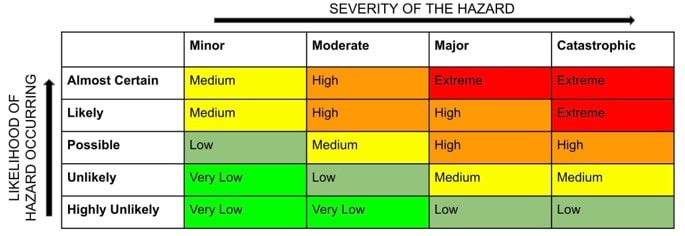
To assess the risk, consider the following questions: Who could potentially be harmed & how it could occur? What is the likelihood of this hazard causing harm to me or to others? (Almost certain, Likely, Possible, Unlikely or Highly Unlikely). How severe would the consequence be if this hazard were to cause harm to someone? (Minor, Moderate, Major or Catastrophic)
3. Control the Risk
Once you have assessed the risk, you should follow & implement the hierarchy of controls listed below. If it is not possible to implement the first control, you should keep going down the list to find the most reasonably practical option: Eliminate the hazard (remove it completely), Substitute (can it be swapped out with something safer), Isolate the hazard (put up barriers, fencing, exclusion zones), Engineering controls (put up scaffolding, handrails, etc), Administrative controls (inform other people on site, signage, etc), PPE (Last reasonable option available).
Wickett Group — Site Induction & SWMS